Socrates Meets Kant by Peter Kreeft
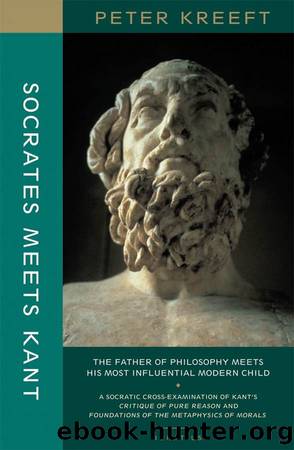
Author:Peter Kreeft [Kreeft, Peter]
Language: eng
Format: epub
Tags: Spiritual & Religion
ISBN: 9781586173487
Publisher: Ignatius Press
Published: 2009-09-16T05:00:00+00:00
11
The Starting Point: A Good Will
SOCRATES: Here is the very first sentence of your book: âThere is no possibility of thinking of anything at all in the world, or even out of it, which can be regarded as good without qualification, except a good will.â (G393)
Why all the qualifications? Why not simply say âThe only thing good without qualification is a good willâ?
KANT: I say âno possibilityâ, not just âno actuality â, and I say âno possibility of thinking of anything . . . â, not just âno possibility of discovering anything . . . â, and I say âanything at all in the world or even out of itâ, to show that this is an a priori. It is not dependent on experience. It is necessary and universal. It is necessary because it is not contingent upon anything else, and it is universal because there is no possible exception to it.
SOCRATES: So if you have found this, you have found your moral absolute. The moral absolute is a good will. Your quest is over. You are finished. The book only needs to be one sentence long. Your end is your beginning.
KANT: No. I am looking for the pole star, remember, not the pole. My first sentence gives you the pole, the human pole, the thing in man that is good-in-itself, and the only such thing. But I have not yet found what makes it good: its standard, its rule, its law. I have found the thing morality judges: human wills. I have found the one who is in the dock, but I have not yet found the one who is on the Judgeâs bench.
SOCRATES: Most people would say that that is God, the absolutely good Being, at the ontological root of absolute moral law.
KANT: I do not deny the existence of God, but I do not rest my morality on the existence of God.
SOCRATES: So you do not believe the statement that âif God does not exist, then everything is permissible.â
KANT: I do not. Just as the law of noncontradiction is a law that binds the minds of everyoneâboth monists and pluralists, materialists and spiritualists, atheists and theists, dogmatists and skeptics, nominalists and realistsâso the moral absolute binds the wills of everyone, including atheists and theists. By the way, was it an atheist or a theist who uttered that statement?
SOCRATES: It was first uttered by a famous nineteenth-century theist named Dostoyevski and then quoted approvingly by a famous twentieth-century atheist named Sartre.
KANT: And I will wager that the theist used it to prove the existence of God from the premise of the existence of moral absolutes, while the atheist used it to prove the nonexistence of moral absolutes from the premise of the nonexistence of God. Am I right?
SOCRATES: You are uncannily right, Emmanuel.
KANT: See? Bringing God into the picture does not solve the problem at all.
SOCRATES: It does if God âs existence can be either proved or disproved.
KANT: But it cannot be proved or disproved. And I think half of humanity agrees with me here.
Download
This site does not store any files on its server. We only index and link to content provided by other sites. Please contact the content providers to delete copyright contents if any and email us, we'll remove relevant links or contents immediately.
| Anthropology | Archaeology |
| Philosophy | Politics & Government |
| Social Sciences | Sociology |
| Women's Studies |
The remains of the day by Kazuo Ishiguro(8961)
Tools of Titans by Timothy Ferriss(8357)
Giovanni's Room by James Baldwin(7313)
The Black Swan by Nassim Nicholas Taleb(7097)
Inner Engineering: A Yogi's Guide to Joy by Sadhguru(6780)
The Way of Zen by Alan W. Watts(6589)
Asking the Right Questions: A Guide to Critical Thinking by M. Neil Browne & Stuart M. Keeley(5747)
The Power of Now: A Guide to Spiritual Enlightenment by Eckhart Tolle(5740)
The Six Wives Of Henry VIII (WOMEN IN HISTORY) by Fraser Antonia(5493)
Astrophysics for People in a Hurry by Neil DeGrasse Tyson(5172)
Housekeeping by Marilynne Robinson(4432)
12 Rules for Life by Jordan B. Peterson(4298)
Double Down (Diary of a Wimpy Kid Book 11) by Jeff Kinney(4257)
The Ethical Slut by Janet W. Hardy(4235)
Skin in the Game by Nassim Nicholas Taleb(4231)
Ikigai by Héctor García & Francesc Miralles(4228)
The Art of Happiness by The Dalai Lama(4118)
Skin in the Game: Hidden Asymmetries in Daily Life by Nassim Nicholas Taleb(3985)
Walking by Henry David Thoreau(3948)
